
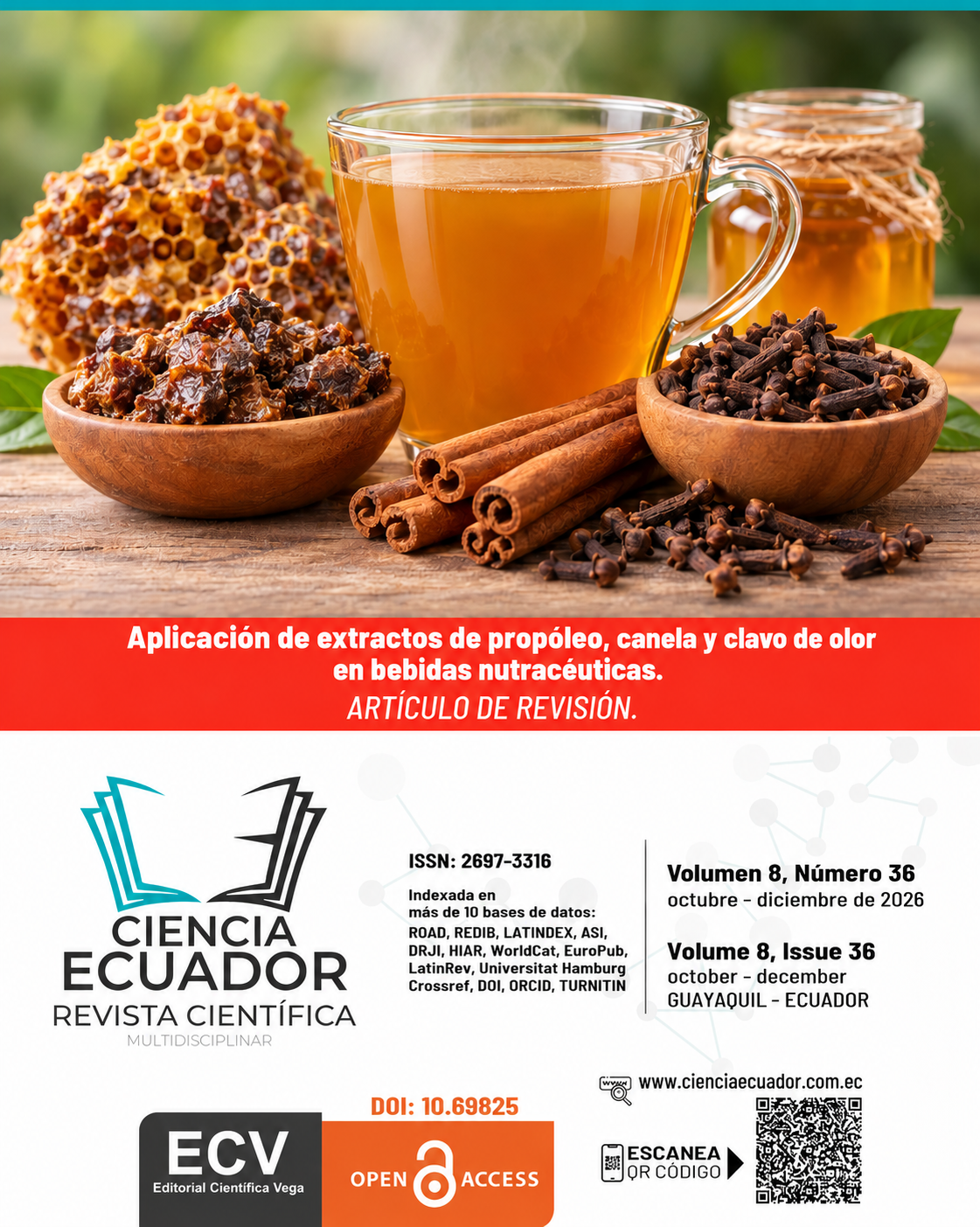
Aplicación de extractos de propóleo, canela y clavo de olor en bebidas nutracéuticas: Revisión
Artículo de Revisión
DOI:
https://doi.org/10.69825/cienec.v8i36.400Abstract
Introducción: El desarrollo de bebidas nutracéuticas enriquecidas con extractos de propóleo, canela y clavo de olor ha despertado interés debido a sus propiedades bioactivas y potencial aplicación en la industria alimentaria. Metodología: Se realizó una revisión sistemática exploratoria siguiendo los lineamientos PRISMA, mediante la búsqueda de estudios publicados entre 2020 y 2025 en Scopus, ScienceDirect, Redalyc, SciELO, Google Scholar, SpringerLink y PubMed. Los artículos seleccionados fueron analizados cualitativamente según sus efectos fitoquímicos, microbiológicos, tecnológicos y sensoriales en bebidas. Resultados: Los estudios mostraron variaciones en los compuestos fenólicos y la actividad antioxidante según el extracto, concentración, matriz y condiciones experimentales. El propóleo presentó efectos favorables sobre parámetros bioactivos y microbiológicos, incluso en bebidas fermentadas, mientras que la canela y el clavo de olor mostraron actividad antioxidante y antimicrobiana en diferentes matrices. Las estrategias de encapsulación evidenciaron potencial para favorecer la estabilidad de algunos compuestos bioactivos y, en determinadas formulaciones, la aceptación sensorial. Conclusiones El propóleo, la canela y el clavo de olor presentan potencial tecnológico y funcional para el desarrollo de bebidas nutracéuticas. Sin embargo, la heterogeneidad de las formulaciones, extractos, concentraciones, métodos de extracción y condiciones de almacenamiento impide establecer una concentración universalmente óptima, por lo que los resultados deben interpretarse de acuerdo con las características específicas de cada producto.
Propolis. Cinnamon. Clove. Antioxidants. Food Preservation. Probiotics
References
Adimas, Z. T., Habitu, T. A., Adimas, M. A., & Abera, B. D. (2024). The effect of concentration of cinnamon extract and storage time on physicochemical, microbial, and sensory attributes of avocado juice. Applied Food Research, 4(2), 100585. https://doi.org/10.1016/j.afres.2024.100585
Akhan, M., Türkol, M., Y?km??, S., Çakmak Sancar, B., Çöl, B. G., Khalid, M. Z., Moreno, A., Khalid, W., & Alsulami, T. (2025). Enhancing the functionality and shelf life of poppy sherbet by optimizing ultrasound and propolis using response surface methodology: Impact on phenolic compounds, organic acids, sugar components, and sensory characteristics. LWT, 218, Artículo 117453. https://doi.org/10.1016/j.lwt.2025.117453
Arslan, K. (2023). The antioxidant, antimicrobial, and total phenolic potential of clove extracts for inhibition of food pathogens. Erzincan University Journal of Science and Technology, 16(2), 453-464. https://doi.org/10.18185/erzifbed.1279953
Batiha, G. E.- S., Alkazmi, L. M., Wasef, L. G., Beshbishy, A. M., Nadwa, E. H., & Rashwan, E. K. (2020). Syzygium aromaticum L. (Myrtaceae): Traditional uses, bioactive chemical constituents, pharmacological and toxicological activities. Biomolecules, 10(2), 202. https://doi.org/10.3390/biom10020202
Bengi, S., Gursoy, O., Güler Dal, H. Ö., & Yilmaz, Y. (2023). Effect of propolis extract addition on some physicochemical, microbiological, and sensory properties of kefir beverages. Food Science & Nutrition, 11(11), 7401-7412. https://doi.org/10.1002/fsn3.3671
Bikheet, M. M., Hassan, H. M., Omar, M. O. A., Abdel-Aleem, W. M., Galal, S. M., Korma, S. A., Ibrahim, S. A., & Nassar, K. S. (2025). Effects of clove (Syzygium aromaticum) extract on antibacterial activity, phytochemical properties, and storage quality of flavored milk beverages. Journal of Dairy Science, 108(4), 3300-3313. https://doi.org/10.3168/jds.2024-26023
Chang, Z. Q., Leong, W., & Chua, L. S. (2021). Statistical approach to reveal propolis as a potential biopreservative for fruit juices. Future Foods, 4, Artículo 100051. https://doi.org/10.1016/j.fufo.2021.100051
Chua, L. S., Chan, Y. L., Tay, Z. Y., & Soo, J. (2023). Water-soluble propolis extract as a natural preservative for jaboticaba juice. Food Bioscience, 53, Artículo 102651. https://doi.org/10.1016/j.fbio.2023.102651
Culas, M. S., Popovich, D. G., & Rashidinejad, A. (2024). Recent advances in encapsulation techniques for cinnamon bioactive compounds: A review on stability, effectiveness, and potential applications. Food Bioscience, 57, 103470. https://doi.org/10.1016/j.fbio.2023.103470
Ferreira, I., de Sousa Melo, D., Santos, M. S., Dias, D. R., de Souza, C. O., Silva, I. M., Schwan, R. F., Dias, F. S., Magalhães-Guedes, K. T., & Duarte, W. F. (2023). Non-lactic probiotic beverage enriched with microencapsulated red propolis: Microorganism viability, physicochemical characteristics, and sensory perception. Fermentation, 9(3), Artículo 234. https://doi.org/10.3390/fermentation9030234
Galán-Méndez, F., Saldaña-Carmona, Y. A., & Melgar-Lalanne, G. (2025). Beverages fortified with cinnamon. En Cinnamon: Production, processing, and functional properties (pp. 499-509). Academic Press. https://doi.org/10.1016/B978-0-443-21820-0.00029-5
Gea, A. V., Anggraini, T., & Azima, F. (2024). Analysis of the financial feasibility of producing an instant drink mixed with Siamese orange peel extract and cinnamon extract. Asian Journal of Applied Research for Community Development and Empowerment, 8(1), 15-20. https://doi.org/10.29165/ajarcde.v8i1.366
Goonathilaka, P. D. S. A., Abeysundara, P. D. A., & Jayasinghe, M. A. (2023). Development of a value added rice milk by utilizing selected traditional and improved rice varieties in Sri Lanka. Food Chemistry Advances, 2, 100319. https://doi.org/10.1016/j.focha.2023.100319
Indiarto, R., Herwanto, J. A., Filianty, F., Lembong, E., Subroto, E., & Muhammad, D. R. A. (2024). Total phenolic and flavonoid content, antioxidant activity and characteristics of a chocolate beverage incorporated with encapsulated clove bud extract. CyTA - Journal of Food, 22(1), 2329144. https://doi.org/10.1080/19476337.2024.2329144
Jayani, N. I. E., Salawane, B. L., Pelopolin, H. Y., & Rani, K. C. (2021). Formulation and evaluation of two types of functional beverage granules made of extracts of guava leaves, purple sweet potato and cinnamon. Tropical Journal of Natural Product Research, 5(6), 1024-1029. http://repository.ubaya.ac.id/id/eprint/39779
Kusalaruk, W., Shimamoto, T., Quan, N. V., Nakano, H., & Caigoy, J. C. (2024). Inactivation of Escherichia coli O157:H7 in tomato juice by combined treatment of ethanolic clove extract and mild heat. Discover Food, 4(1), 119. https://doi.org/10.1007/s44187-024-00211-7
Lestari, N., Junaidi, L., Hartanto, E. S., Hasrini, R. F., Aviana, T., Silitonga, R. F., & Khoiriyah, A. (2024). Physicochemical character and antioxidant activity of lemon (Citrus Limon (L.) BURM. F.) beverage with addition of spice extract and honey as a functional drink. AIP Conference Proceedings, 2957(1), 060015. https://doi.org/10.1063/5.0185400
Liao, N., Sun, L., Wang, D., Chen, L., Wang, J., Qi, X., Zhang, H., Tang, M., Wu, G., Chen, J., & Zhang, R. (2021). Antiviral properties of propolis ethanolic extract against norovirus and its application in fresh juices. LWT, 152, 112169. https://doi.org/10.1016/j.lwt.2021.112169
Lopes, G. A., Fidelis, P. C., de Almeida, B. M., Almeida, J. J., Lentz, G. de A. S., Binda, N. S., Teixeira, A. F., Vieira-Filho, S. A., Caligiorne, R. B., Saúde-Guimarães, D. A., Brumano, M. H. N., & de Figueiredo, S. M. (2022). Antioxidant activity, sensory analysis and acceptability of red fruit juice supplemented with Brazilian green propolis. Food Science and Technology, 41(suppl 2), 579-586. https://www.scielo.br/j/cta/a/p4sNnz65hhNGXTmDk8zJx3g/?lang=en
Maleš, I., Pedisi?, S., Zori?, Z., Elez-Garofuli?, I., Repaji?, M., Tu, L., Vladimir-Kneževi?, S., Butorac, D., & Dragovi?-Uzelac, V. (2022). The medicinal and aromatic plants as ingredients in functional beverage production. Journal of Functional Foods, 95, 105210. https://doi.org/10.1016/j.jff.2022.105210
Manchado, R., Tamames, S., López, M., Mohedano, L., D’Agostino, M., & Veiga de Cabo, J. (2009). Revisiones sistemáticas exploratorias. Medicina y Seguridad del Trabajo, 55(216), 12–19. https://scielo.isciii.es/scielo.php?script=sci_arttext&pid=S0465-546X2009000300002
Michailidis, G. F., Thamnopoulos, I. A. I., Fletouris, D. J., & Angelidis, A. S. (2020). Synergistic, bacteriostatic effect of propolis and glycerol against Listeria monocytogenes in chocolate milk under refrigerated storage. Food Science and Technology International, 27(3), 238-246. https://doi.org/10.1177/1082013220929150
Milian Mindiola, P. E. (2022). Elaboración de néctares de pera, durazno y manzana utilizando como agente conservante extractos acuosos de canela (Cinnamomum verum). Revista de Ciencias, 25(1). https://doi.org/10.25100/rc.v25i1.11579
Mirzazadeh, M., Bagheri, H., Rasi, F., Mirzazadeh, N., Alam, Z., & Akhavan-Mahdavi, S. (2024). Optimization of instant beverage powder containing propolis extract nanoliposomes. International Journal of Food Science, 2024, 9099501. https://doi.org/10.1155/ijfo/9099501
Oessoe, Y. Y. E., Assa, J. R., Paat, F. J., Tangkeallo, S. C. T., Tooy, D., Koapaha, T., Tumbelaka, S., Mamuaja, C. F., & Latumakulita, L. A. (2023). Antioxidant activity on sarrabba is based on the proportion of red ginger extract (Zingiber officinale Roscoe) and cinnamon extract (Cinnamomum verum J. Presl). Journal of Agriculture (JoA), 2(2), 205-213. https://doi.org/10.47709/joa.v2i02.2832
Page, M. J., McKenzie, J. E., Bossuyt, P. M., Boutron, I., Hoffmann, T. C., Mulrow, C. D., Shamseer, L., Tetzlaff, J. M., Akl, E. A., Brennan, S. E., Chou, R., Glanville, J., Grimshaw, J. M., Hrobjartsson, A., Lalu, M. M., Li, T., Loder, E. W., Mayo-Wilson, E., McDonald, S., ... Moher, D. (2021). The PRISMA 2020 statement: an updated guideline for reporting systematic reviews. BMJ, 372, n71. https://doi.org/10.1136/bmj.n71
Rodríguez Pérez, B., Canales Martínez, M. M., Penieres Carrillo, J. G., & Cruz Sánchez, T. A. (2020). Composición química, propiedades antioxidantes y actividad antimicrobiana de propóleos mexicanos. Acta Universitaria, 30. https://doi.org/10.15174/au.2020.2435
Saad, A. M., Mohamed, A. S., & Ramadan, M. F. (2020). Storage and heat processing affect flavors of cucumber juice enriched with plant extracts. International Journal of Vegetable Science. 27(3), 277- 287. https://doi.org/10.1080/19315260.2020.1779895
Saad, A. M., Mohamed, A. S., El-Saadony, M. T., & Sitohy, M. Z. (2021). Palatable functional cucumber juices supplemented with polyphenols-rich herbal extracts. LWT, 148, 111668. https://doi.org/10.1016/j.lwt.2021.111668
Saati, E. A., Haprinata, E. E., Winarsih, S., Wachid, M., & Wahyudi, V. A. (2021). Physicochemical and sensory characteristics of rose-spices as functional beverage. Foodscitech, 4(1), 16-26. https://doi.org/10.25139/fst.v4i1.3798
Sidor, A., Dro?d?y?ska, A., Brzozowska, A., Szwengiel, A., & Gramza-Micha?owska, A. (2020). The effect of plant additives on the stability of polyphenols in cloudy and clarified juices from black chokeberry (Aronia melanocarpa). Antioxidants, 9(9), 801. https://doi.org/10.3390/antiox9090801
Singh, N., Rao, A. S., Nandal, A., Kumar, S., Yadav, S. S., Ganaie, S. A., & Narasimhan, B. (2021). Phytochemical and pharmacological review of Cinnamomum verum J. Presl-a versatile spice used in food and nutrition. Food Chemistry, 338, 127773. https://doi.org/10.1016/j.foodchem.2020.127773
Tumbarski, Y. D., Petrova, N., Ivanov, I., Petkova, N., Ivanova, P., Yanakieva, V., Vasilev, K., & Mihalev, K. (2023). Assessment of the bioactivity, preservation potential and sensory acceptance of a propolis extract applied in a functional fruit-herbal beverage. Functional Food Science and Technology, 6(2), 163-175. https://doi.org/10.30721/fsab2023.v6.i2.302
Turko?lu Bacanak, R., & Keyvan, E. (2024). Assessment of propolis-fermented Kombucha tea's microbiological, physicochemical and sensory characteristics. Emirates Journal of Food and Agriculture, 36, 118977. https://doi.org/10.3897/ejfa.2024.118977
Umam, N. I., & Firdaus, M. (2020). Formula optimization of functional beverages from Sargassum sp., Cinnamomum burmannii, and Curcuma xanthorrhiza Roxb with a-Glucosidase inhibitor activity. IOP Conference Series: Earth and Environmental Science, 493(1), 012031. https://doi.org/10.1088/1755-1315/493/1/012031
Xue, Q., Xiang, Z., Wang, S., Cong, Z., Gao, P., & Liu, X. (2022). Recent advances in nutritional composition, phytochemistry, bioactivities, and potential applications of Syzygium aromaticum L (Myrtaceae). Frontiers in Nutrition, 9, 1002147. https://doi.org/10.3389/fnut.2022.1002147
Y?km??, S., Türkol, M., Tokatl? Demirok, N., Tokatl?, N., Rüzgar, E., Mohamed Ahmed, I. A., & Aljobair, M. O. (2025). Sustainable valorization of yellow cherry juice using natural propolis and non-thermal techniques. Frontiers in Sustainable Food Systems, 9, 1606602. https://doi.org/10.3389/fsufs.2025.1606602
Downloads
Published
How to Cite
Issue
Section
License

This work is licensed under a Creative Commons Attribution-NonCommercial-ShareAlike 4.0 International License.
This is a human-readable summary of (and not a substitute for) the license.
You are free to:
Share — copy and redistribute the material in any medium or format
Adapt — remix, transform, and build upon the material
The licensor cannot revoke these freedoms as long as you follow the license terms.
Under the following terms:
Attribution — You must give appropriate credit, provide a link to the license, and indicate if changes were made. You may do so in any reasonable manner, but not in any way that suggests the licensor endorses you or your use.
NonCommercial — You may not use the material for commercial purposes.
ShareAlike — If you remix, transform, or build upon the material, you must distribute your contributions under the same license as the original.
No additional restrictions — You may not apply legal terms or technological measures that legally restrict others from doing anything the license permits.
Notices:
You do not have to comply with the license for elements of the material in the public domain or where your use is permitted by an applicable exception or limitation.
No warranties are given. The license may not give you all of the permissions necessary for your intended use. For example, other rights such as publicity, privacy, or moral rights may limit how you use the material.

